

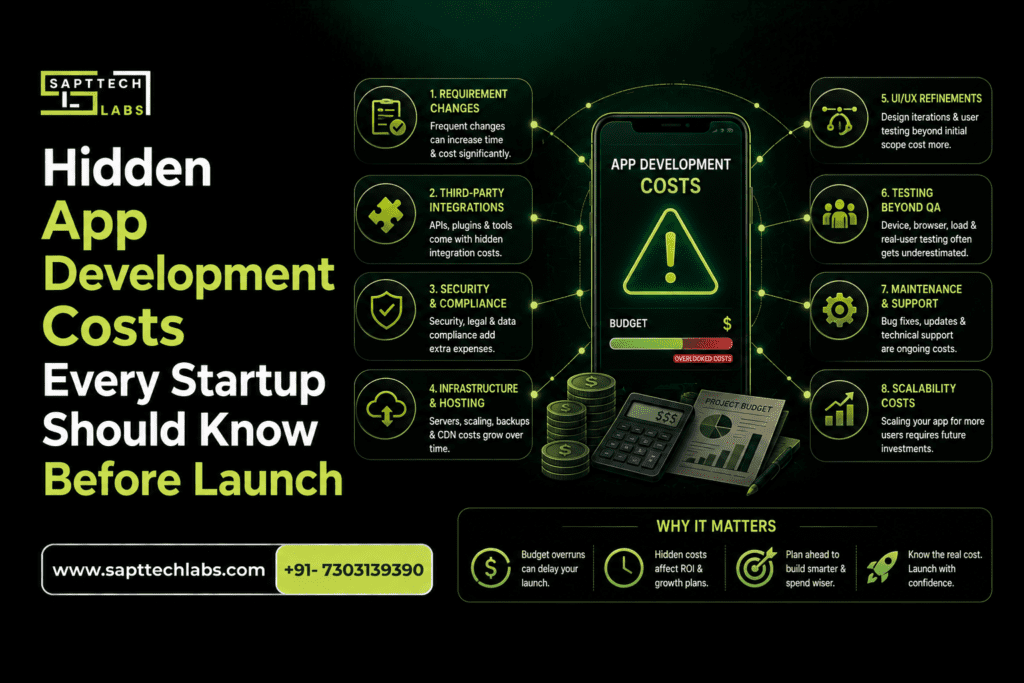
Hidden App Development Costs Every Startup Should Know Before Launch
Getting a mobile application for your business has become an important achievement for any startup. The first thought coming to mind when creating a mobile app is usually related to getting a quote for its development and assuming that all the expenditures will come only at this stage. But this opinion is far from being true.
According to industry reports, approximately 70% of software development projects exceed their projected budget. This may happen because of various expenses associated with maintenance, infrastructure, integration of third-party services and others. It is crucial to understand these 3rd part expenses beforehand just to avoid unexpected recurring costs in the future.
Why Startups Often Underestimate App Development Costs
The cost startup companies receive for app development covers UI/UX design, development, and even testing processes. But there are various costs associated with app development gets overlooked or underestimated by the client, such as server cost, API cost and lastly maintenance cost after the free support period.
Some of the questions raised by many startup founders include:
- What are the hidden costs of app development?
- Why does app development cost more than quoted in the estimate?
- What are the other expenses besides those in the app development estimate?
- How can startups save from these hidden app development expenses?
Another thing many startups end up doing is developing more features which are unneeded. There is evidence that suggests that up to 45% of software features aren't used, but still, they keep spending on them.
Let's discover the hidden app development costs faced by startups.
1. UI/UX Design Revisions
However, initial designs will most likely require several rounds of updates due to feedback from users, stakeholders, and market analysis that might increase:
- Time spent designing
- Efforts in development
- Duration of project work
The larger the number of redesigns, the higher the total cost of the project. Most startups fail to consider the influence of increasing costs associated with scope creep during app development process that start with minor updates to the design.
Book A Free Consultation!
2. Third Party API and Integration Costs
Contemporary apps depend on the usage of external services for payment systems, maps, text verifications, push notifications, analytics systems, chats, and other advanced features powered by AI technology.
Common User Question:
Is API Integration Part Of Your App Development Pricing?
Most often, APIs usage is charged additionally. This means that third-party API integration costs play a crucial role in the budgeting process and need to be considered.
Typically, the mobile application uses 5-15 third-party services. Moreover, as the amount of users is growing, so are the API costs. On average, API integration costs increase annually between 20% and 50%.
3. Cloud Hosting and Infrastructure Expenses
Your application will require some infrastructure to operate effectively.
The cost of Infrastructure may include:
- Hosting in the cloud
- Storage of data
- Delivery network of content (CDN)
- Management of database
- Backup system
Question from Common Users:
What are the cost implications of app hosting and server?
Hosting and server cost for an app can range between $100 and $5,000 per month depending on traffic and the complexity of the app. Cloud Infrastructure for mobile apps, for instance, contributes 5% to 15% of the annual costs of operation.
As you scale up, infrastructure cost increases in proportion to your success rate.
4. Quality Assurance and Testing
Testing is one of the crucial parts of app development process.
The process of testing should involve:
- Functionality testing
- Performance testing
- Security testing
- Compatibility testing of devices
- User acceptance testing
Question from Common Users:
What is the cost implication of testing and QA process?
Most businesses ignore testing costs for apps while in reality testing makes up 15% to 30% of the entire budget.
In addition, studies show that repairing bugs after the release is 4-5 times more expensive compared to the repair during the development phase.
5. App Store and Publishing Fees
Distribution of apps also has hidden costs.
These include:
- Fees for Apple Developer Program
- Fees for Google Play Console
- App Store Optimization (ASO)
- Help with the app submission process
Common Question from Users:
What Are Hidden Costs Associated With Launching Your App on the App Store and Google Play?
Apart from paying fees for developer accounts, your startup might spend extra cash on optimization and promotion activities. You must take into account the cost of the application store and the publication process each time you create a new app.
6. Security Needs
No security means no business.
Depending on the sphere of operation, your company might be required to implement:
- GDPR compliance
- Data encryption
- Auditing of security issues
- Payment processing
- A proper privacy policy
Neglecting the security requirements will lead to serious financial and reputational loss for your company.
As per IBM's report on data breaches, it would cost over $4 million to fix the problem.
7. Scope Creep
One of the biggest unseen costs in building apps is scope creep.
This occurs whenever new elements are incorporated into the app while it is already under development.
Such additions include:
- New user profiles
- Additional integration services
- Improved dashboard capabilities
- Artificial intelligence capabilities
- New payment methods
Common Customer Inquiry:
Why is app development overrun in budget?
The costs associated with app development scope creep are some of the major causes of budgets going above projections. A seemingly small addition can involve considerable modifications in the backend and front end.
8. Post-Launch Maintenance
It's not all done once the app is launched.
Post-launch maintenance includes:
- Bug fixing
- Security updates
- Updates to OS compatibility
- Enhancements to features
- Optimization of performance
Common Customer Question:
What are the costs of maintaining a mobile app post-launch?
One of the largest overlooked costs is that associated with the maintenance of a mobile app post-launch. Experts suggest allocating up to 15% to 20% of the initial development cost annually for maintenance purposes.
That means an app worth $50,000 will have annual app maintenance costs of between $7,500 and $10,000.
9. Marketing and User Acquisition Costs
One of the biggest unseen costs in building apps is scope creep.
This occurs whenever new elements are incorporated into the app while it is already under development.
Such additions include:
- New user profiles
- Additional integration services
- Improved dashboard capabilities
- Artificial intelligence capabilities
- New payment methods
Common Customer Inquiry:
Why is there app development overrun in budget?
The costs associated with app development scope creep are some of the major causes of budgets going above projections. A seemingly small addition can involve considerable modifications in the backend and front end.
10. Crisis and Technical Debt Solutions
Some problems may come up suddenly:
- Downtime issues
- Security gaps
- Performance problems
- Urgent fixes for bugs
In order not to disrupt enterprise processes, it’s worth having a reserve budget.
Technical debt can increase the overall price of development by 20% to 40%, which is another reason why it's so crucial to know the actual cost of development.
People Also Ask
Do app maintenance costs get included in development costs?
Typically, they don't. App maintenance costs after deployment can be separate from the development costs.
How much do annual updates for an app cost?
Most companies allocate around 15%–20% of the initial development costs for yearly updates.
Do cloud hosting costs rise with an increase in app users?
They will likely rise due to increased infrastructure requirements on the cloud.
What will happen if app specifications change while being developed?
It will most likely mean added app development hours, meaning app development cost creep.
How much budget should be set aside for marketing?
Most professionals suggest putting aside at least 20%–30% of the development costs for marketing purposes.
Final Thoughts
It's important to be aware of the various costs associated with mobile application development, which is true for all startups. Although quotes for development help give an initial idea about the cost, various other expenses associated with hosting, maintenance, testing, security, integration, and marketing should be considered before you have your final figure.
For example, while a startup may consider spending only $50,000 on developing an app, the final expenditure might amount to $65,000-$80,000, and even more depending on other factors.
By being aware of hidden costs associated with mobile application development, such as API integration costs, cloud infrastructure costs, and even the hidden costs of creating MVPs, startups will be able to manage their budget effectively.