

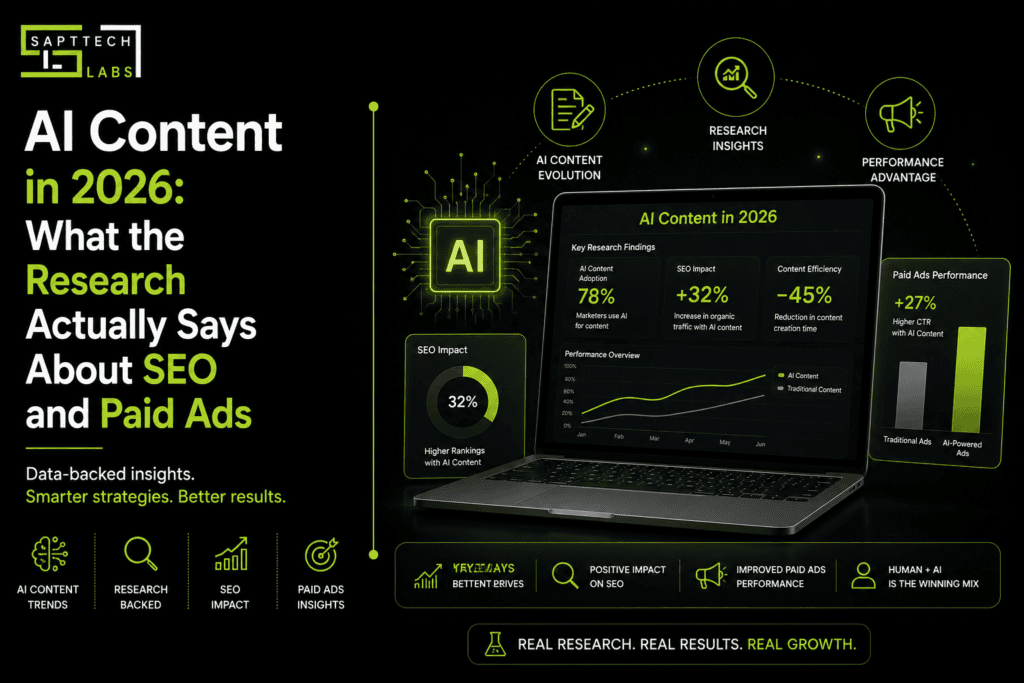
AI Content in 2026: What the Research Actually Says About SEO and Paid Ads
Ask ten marketers whether AI-generated content actually works for SEO and paid advertising, and you'll get ten slightly different answers. Some swear by it. Others still think Google is quietly punishing anyone who touches a chatbot. Neither camp has the full picture.
Here's the honest answer: yes, AI content works, but only when someone with actual judgment is steering it. Left on autopilot, it falls flat fast.
By 2026, AI has moved well past "help me write a blog post." It's doing keyword research, drafting landing pages, spinning out ad variations, and personalizing content at a scale no team of humans could match on their own. But the campaigns and websites actually winning right now aren't the ones that let AI run the whole show. They're the ones where a person is still fact-checking, editing, and making the judgment calls AI can't make for itself.
Let's get into what's actually happening and what to do about it if you want your content and ads to hold up.
AI Content Has Grown Up
It's not just writing blog posts anymore. Marketers are now leaning on AI tools for:
- Drafting SEO-friendly articles
- Writing landing page copy
- Producing Google and Meta ad creative
- Suggesting keywords worth chasing
- Testing headline variations
- Building out email sequences
- Personalizing on-site content
- Digging into what competitors are publishing
- Refreshing old, stale articles
None of that replaces a marketer. It just means the marketer isn't stuck doing the tedious first-draft grind anymore and they get to spend their time on strategy instead.
So, Does AI Content Actually Rank?
Here's a myth that needs to die: Google does not automatically penalize content just because it was written with AI help. That's not how it works, and it never really was.
What Google actually cares about is whether the content is good. Is it helpful? Accurate? Does it sound like it was written by someone who actually knows the topic? That's the bar — not "human or machine."
AI-assisted content tends to do well when it has:
- A genuine point of view, not just recycled talking points
- Real expertise behind it
- Accurate, checked information
- Examples that actually illustrate something
- Solid internal linking
- Current stats, not numbers from three years ago
- Writing that's easy to actually read
Where it falls apart is when nobody bothers to edit it. Thin, generic, copy-pasted-feeling AI content struggles, not because a robot wrote it, but because it's boring and says nothing new.
What the SEO Data Is Showing
Talk to enough SEOs running case studies, and a pattern emerges. Teams using AI well are able to:
- Publish more content, faster
- Actually cover the long tail of keyword opportunities instead of ignoring it
- Keep old content fresh instead of letting it rot
- Scale into multiple languages without hiring a translator for every market
- Build topical authority faster than they could manually
The common thread in all of it? Nobody's just hitting "publish" on raw AI output. The strongest results come from AI drafting fast, and a human editor tightening it up before it ever goes live.
Book A Free Consultation!
AI Is Quietly Changing Paid Ads Too
If there's one place AI has made an outsized difference, it's paid advertising. Marketing teams are now using it to build out:
- Google Search Ads
- Performance Max headlines
- Meta Ads
- LinkedIn Ads
- Display creative
- YouTube ad scripts
The real win here is speed. AI can spit out dozens of ad variations in the time it'd take a person to write three. That means more A/B testing, more personalization, and faster campaign launches overall.
But — and this is important — none of that replaces a human checking that the tone actually fits the brand and the audience. AI doesn't know your brand's personality. It just knows patterns.
Why You Still Need a Human in the Loop
AI is genuinely great at generating options. Where it tends to stumble:
- It repeats the same generic points other content already makes
- It misses the small nuances specific to your industry
- It defaults to safe, generic phrasing
- It occasionally just gets facts wrong
- It struggles with actual emotional storytelling
That's exactly where a human editor earns their keep — bringing in brand voice, catching errors, sharpening the strategy, adding real customer insight, and writing calls-to-action that don't sound like they came from a template.
The content that performs best isn't "AI content" or "human content." It's both, working together.
If You Want AI Content to Actually Rank, Do This
Start with real keyword research. Figure out what your audience is actually searching for, not just what sounds good.
Write for intent, not keywords. Answer the actual question someone typed into Google. Keyword stuffing hasn't worked in years.
Add something AI can't. A case study, an expert opinion, a comparison based on real experience — anything that proves a human was actually involved.
Make it easy to read. Short paragraphs, clear headings, bullet points where they help, tables when they make sense, and an FAQ section if it fits.
Keep it updated. Content that sits untouched for years starts to slip. Refresh it.
Making AI Work Harder for Your Paid Campaigns
A few things that consistently move the needle:
- Test more headlines than feels necessary — you'll be surprised what wins
- Write several ad description variants, not just one
- Personalize messaging by audience segment instead of blasting the same copy to everyone
- Sharpen your CTAs
- Refresh creative regularly instead of letting the same ad run for months
- Actually look at the performance data instead of guessing
And always, always review AI-generated copy before it goes live — for accuracy, for tone, and to make sure it's not accidentally breaking a platform's ad policy.
Mistakes That Keep Showing Up
Some of these should be obvious by now, but they keep happening:
- Publishing AI drafts with zero editing
- Stuffing keywords in unnaturally
- Ignoring what the searcher actually wants
- Reusing the same AI output across multiple pages
- Skipping fact-checking entirely
- Publishing thin content just to hit a quota
- Automating things that genuinely need a human touch
AI should make your workflow faster. It shouldn't replace the thinking part.
Why Bother With Any of This?
Done right, AI gives you real advantages: faster turnaround, lower production costs, easier scaling, quicker updates, sharper personalization, and way more room for testing. That matters a lot if you're an agency, an eCommerce brand, a SaaS company, or a publisher trying to keep up with a constant content demand.
Quick Questions People Keep Asking
Is AI-generated content good for SEO?
Yes — when it's accurate, original, genuinely useful, and edited by someone who knows what they're doing. Skip the editing and it usually shows.
Does Google penalize AI content?
No, not just for being AI-written. It penalizes low-quality, unhelpful content — regardless of who or what wrote it.
Can AI actually improve Google Ads performance?
It helps you test more variations faster and personalize at scale. But strategy, targeting, and ongoing optimization still come down to you.
Should you publish AI content without editing it?
No. Skipping that step is where most of the "AI content doesn't work" complaints actually come from.
Is AI replacing content writers?
Not really — it's changing what writers spend their time on. The strategic thinking, the voice, the judgment calls: still human work.
Which industries get the most out of this?
eCommerce, education, healthcare, finance, SaaS, tech, real estate, and marketing all lean on it heavily — as long as there's expert oversight behind it.
The Bottom Line
AI isn't a shortcut around good content strategy — it's a tool that makes good strategy move faster. The brands winning in 2026 aren't the ones that automated everything. They're the ones using AI to handle the heavy lifting while people stay focused on what only people can do: judgment, voice, and actually understanding the audience.
If you're chasing better rankings or stronger ad performance, that's really the whole game — build for the person searching, use AI to move faster, and never skip the human review.