

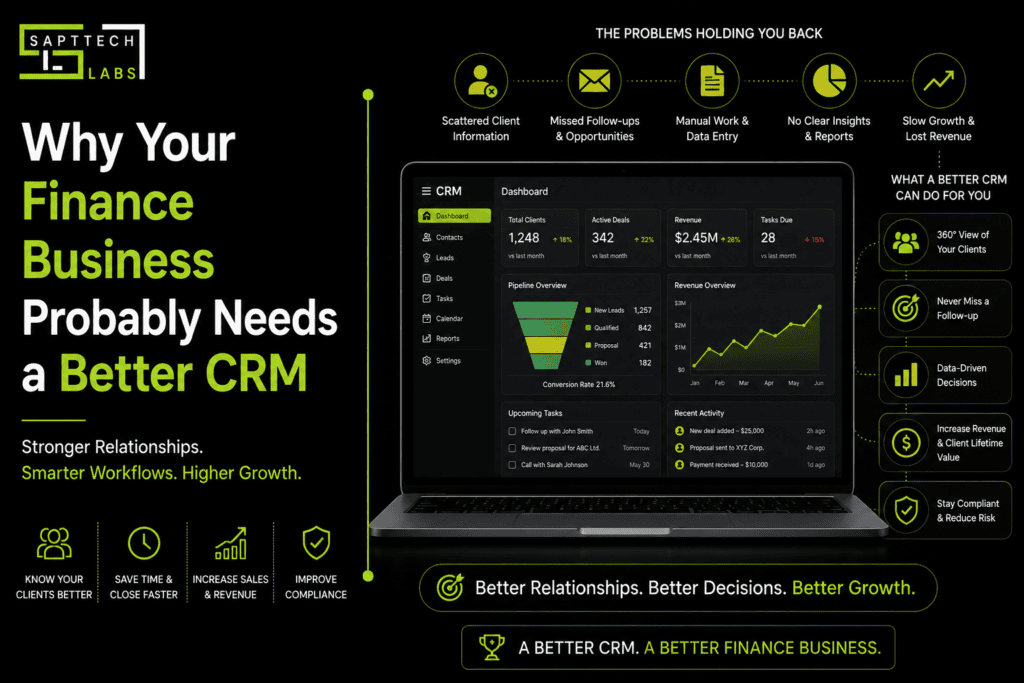
Why Your Finance Business Probably Needs a Better CRM (And What to Look For)
If you're running a financial advisory firm, an insurance shop, a lending business, or an investment management outfit, you already know client relationships are the whole game. Lose that trust, and it doesn't matter how good your rates are. So the real question isn't whether you need to manage customer information well — it's whether you're still doing it the hard way.
That's the gap a good CRM finance solution is meant to close.
What Exactly Is a CRM Finance Solution?
At its core, it's software built to help financial organizations manage client interactions, automate the repetitive stuff, and keep people coming back. Most finance teams end up using one to track leads, automate follow-ups, store sensitive documents securely, run reports, and stay on the right side of regulators.
The difference between this and a generic CRM? Finance-focused platforms usually bake in extra layers of security and compliance tooling that a regular sales CRM just doesn't bother with — because a missed follow-up email is annoying, but a compliance slip-up can actually sink you.
Why Bother in the First Place
Clients expect fast, personal service now. That's just the baseline. Without a decent system behind the scenes, most finance businesses end up wrestling with the same handful of problems: customer data scattered across spreadsheets and inboxes, follow-ups that fall through the cracks, retention numbers that quietly slide, and compliance headaches that eat up hours nobody has to spare.
A CRM built for this space fixes a lot of that — not by magic, but by giving your team one place to work from and a way to make decisions based on actual data instead of gut feel.
What the Good Ones Actually Do
They centralize everything. Customer profiles, interaction history, financial records, communication logs, documents — all in one spot instead of scattered across five tools. When a client calls, whoever picks up the phone should be able to see the full picture in seconds, not go digging through old emails.
They handle lead management without you babysitting it. Tracking, scoring, segmentation, automated reminders — the stuff that used to eat up someone's whole morning now mostly runs itself. That frees your team up to actually talk to people instead of chasing spreadsheets.
They've gotten genuinely smart about analytics. AI has changed what these platforms can do — behavior analysis, revenue forecasting, risk flags, personalized recommendations. It's not perfect, and it won't replace judgment, but it does catch patterns a busy human might miss.
They take compliance seriously. Secure storage, audit trails, permission-based access, built-in reporting — this is the part that used to require a small army of people manually tracking paperwork. Automating it doesn't just save time; it cuts down on the kind of human error that gets businesses in real trouble.
They live in the cloud. Remote access, automatic updates, easier scaling, lower infrastructure costs — your team can pull up a client's file from anywhere, which matters more now than it did five years ago.
They play nice with everything else you're already using. Accounting software, payment gateways, marketing tools, calendars — a CRM that doesn't talk to the rest of your stack just creates more duplicate work, not less.
Book A Free Consultation!
The Payoff
Do this well and you'll usually see it show up in the obvious places: happier clients, faster response times, better conversion on leads, and a team that isn't drowning in busywork. But the bigger win is less tangible — you start actually knowing your customers instead of guessing.
Okay, But It's Not All Upside
No CRM is a silver bullet, and anyone who tells you otherwise is selling something.
The upfront cost can sting. Licensing, custom development, staff training, data migration, integration work — enterprise-grade platforms aren't cheap, and the bill adds up fast if you don't plan for it.
There's a learning curve. Your team will need real time to get comfortable with dashboards, automated workflows, and new reporting tools. Skip the training and you'll end up with an expensive system nobody actually uses properly.
Not every platform fits every business. Some finance operations need custom workflows or industry-specific modules that an off-the-shelf CRM just doesn't offer. Picking something scalable up front saves you a painful migration later.
Security is still your job. Cloud providers handle a lot, but access management, user permissions, and data governance are still on you. A CRM doesn't outsource your responsibility — it just gives you better tools to meet it.
So How Do You Actually Pick One?
Before you sign anything, it's worth sitting with a few honest questions: Does it actually support how finance businesses work, or is it a repurposed sales tool? Can it grow with you, or will you outgrow it in two years? Does it genuinely automate things, or just promise to? Is it built with regulatory requirements in mind? Will it integrate with what you already run? Is support actually responsive when something breaks?
Pick based on where your business is headed, not just what solves this month's headache.
Where This Is All Heading
CRM tech in finance isn't standing still. AI-driven automation, predictive analytics, voice-enabled tools, sharper personalization, smarter chat support, and stronger cybersecurity are all becoming standard rather than nice-to-haves. Businesses that get ahead of these shifts tend to end up delivering the kind of fast, personal service clients now just expect as a baseline.
Quick Answers to Common Questions
What does CRM actually do in financial services?
It helps manage client relationships, automate the repetitive workflows, stay compliant, and personalize the customer experience — without needing a bigger team to do it.
Who actually uses these?
Financial advisors, banks, insurers, investment firms, wealth managers, lenders, and fintech companies — basically anyone whose business depends on trust and repeat clients.
Are cloud-based ones actually secure?
Most reputable platforms come with solid encryption, access controls, and compliance features built in. That said, security is only as good as how you implement it — the tool isn't a substitute for good internal practices.
Does this actually help with retention?
Generally, yes. Faster responses and more personal communication tend to keep people around longer. It's not magic, but it does move the needle.
Is AI actually important here, or just marketing?
It's become genuinely useful — better insights, less manual work, and more accurate predictions about customer behavior. That said, it works best as a support tool, not a replacement for someone who knows the client.
What should I weigh before committing to one?
Scalability, security, integrations, real automation (not just marketed automation), compliance fit, pricing, and how responsive their support actually is when things go sideways.
The Bottom Line
A good CRM finance solution does more than just store contact info — it's meant to make your business run tighter, keep clients closer, and help you make better calls with the data you're already sitting on. Automation, AI-backed insights, compliance support, cloud access — it's a lot of capability packed into one platform.
But it's not effortless. There are real costs, a real learning curve, and real security responsibilities that don't just disappear because you bought good software. The businesses that get the most out of a CRM are the ones that pick a platform that fits where they're going, not just where they are right now — because in financial services, the relationship is the business. The right tool just helps you actually keep it.