

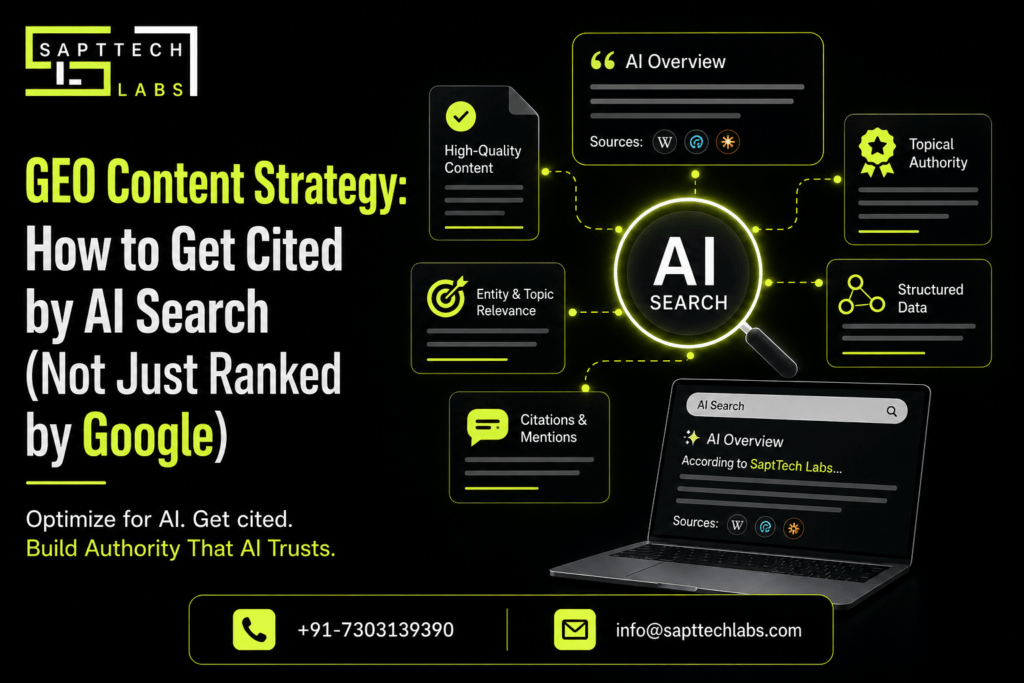
GEO Content Strategy: How to Get Cited by AI Search (Not Just Ranked by Google)
Search is changing faster than most marketers want to admit. People aren't just typing keywords into Google and scrolling through blue links anymore, instead they're asking ChatGPT, Perplexity, Copilot, and Google's AI Overviews for a straight answer. No clicking, no comparing ten tabs. Just: tell me what I need to know.
That shift has created a genuinely new priority for content marketers: getting your brand cited inside those AI-generated answers.
Traditional SEO is still about ranking pages. Generative Engine Optimization (GEO), if you want the acronym, goes a layer deeper. It's about structuring content so AI systems can actually understand it, trust it, and pull from it when they're building an answer. This isn't about ditching SEO for something shinier. It's about realizing you now need a strategy that works in both worlds at once.
Okay, so what actually is GEO?
GEO is the practice of creating and structuring content so it's more likely to get discovered, understood, and cited by generative AI search tools.
Traditional SEO asks: how do I rank #1 for this keyword? GEO asks a different question entirely: how do I become one of the sources an AI system actually trusts when it's answering this?
That distinction matters more than it sounds like it should. AI search tools don't hand back a list of ten links and let you sort it out yourself, but they synthesize an answer from multiple sources based on what they judge to be relevant and reliable. Getting cited means earning a spot in that judgment call, which takes clear answers, real expertise, solid sourcing, and content structured in a way that's easy to pull apart and quote.
Book A Free Consultation!
GEO vs.Traditional SEO — Where They Actually Differ
Traditional SEO | GEO Content Strategy |
Focuses on search rankings | Focuses on AI visibility and citations |
Targets keywords | Targets questions, entities, topics, and intent |
Optimizes for search engine crawlers | Optimizes for AI understanding and retrieval |
Emphasizes backlinks and rankings | Emphasizes authority, evidence, and quotable information |
Optimizes title tags and meta descriptions | Optimizes answer ready content |
Measures rankings and organic traffic | Measures citations, mentions, AI visibility, referral traffic |
Primarily SERP focused | Multi-platform search focused |
Here's the thing though, this was never really an "either/or" situation. It's SEO and GEO,
Why Chasing Citations Matters As Much As Chasing Rankings
Ranking #1 on Google is still worth something. But it's no longer the only door people walk through to find you. Say someone asks an AI assistant, "what are the best online tuition platforms for Class 12 students?" Instead of opening ten tabs, they just read whatever shortlist the AI hands back and if your site is one of the sources behind that answer, you've just gotten visibility before the user even touched a traditional search result.
That's a new kind of organic funnel: query → AI-generated answer → brand citation → website visit → conversion. Your content now has to earn its place not just by ranking, but by being useful enough to cite as evidence.
What actually makes AI search pick your content
Nobody's published the exact formula which these companies guard that closely, but a few patterns show up again and again in what gets referenced.
Topical relevance
If someone searches "how much does mobile app development cost?", a page that actually breaks down pricing factors and development stages beats a vague "About Our App Services" page every time. Obvious, maybe, but you'd be surprised how many sites still get this wrong.
Clear, upfront answers
Don't bury the answer under 2,000 words of throat-clearing. Open with something like: GEO is a content optimization approach designed to improve a brand's visibility in AI-generated search results and increase the odds that AI systems cite its content. Then go deeper.
Real evidence
Back up meaningful claims with actual data like research, statistics, government sources, original studies, expert commentary. The bigger the claim, the stronger the backup needs to be.
Genuine expertise
There's a flood of generic content out there, and AI search is increasingly good at telling the difference between something written to rank and something written by someone who actually knows the subject. Author credentials, original research, real case studies, first hand experience are things that carry weight now.
Build Around Questions, Not Just Keywords
One of the bigger mental shifts in GEO is moving away from planning content around a single keyword. Instead of writing one article targeting "GEO strategy," build a cluster around the actual questions people (and AI systems) are asking:
- What is GEO?
- How does generative engine optimization work?
- How is GEO different from SEO?
- How do I optimize content for AI search?
- How can a website get cited by ChatGPT?
- What makes content AI-search friendly?
- Does traditional SEO still matter for AI search?
- How do AI search engines choose sources?
- How can businesses measure GEO performance?
That's a question-driven ecosystem, not a single article hoping to catch one search term.
Write Answer-First,Aalways
Don't open every section with three paragraphs of throat clearing before you get to the point. Structure it: question → direct answer → explanation → evidence → example.
For instance: how do you optimize content for AI search? You create authoritative, factually supported, clearly structured content that directly answers user questions and makes the important information easy for AI systems to pull out and understand. Then you explain the how: structure, evidence, expertise signals, related questions, keeping things current.
This does double duty, which is genuinely more useful for a human reader skimming for an answer, and it's easier for AI systems to lift a clean, self contained passage out of.
The "Citable Content" Test
Before you publish, ask yourself honestly: could an AI system confidently quote this paragraph as evidence? A passage that passes that test tends to be specific rather than vague, "SEO helps businesses increase visibility in unpaid search results by improving how search engines discover and rank their pages" beats "SEO is extremely important for businesses," which says basically nothing. It should also stand on its own without needing five paragraphs of context, stick to facts rather than opinion, stay concise, and back up anything measurable or debatable with real support.
Strengthen your E-E-A-T signals (yes, still)
GEO isn't just a rebrand of E-E-A-T, but the underlying principles — experience, expertise, authority, trust — still carry real weight. Make it obvious who wrote the content and why they're qualified. Cite where your information actually came from. Keep things updated, and don't let stale statistics sit there for two years. And if you're a company writing about your own industry, actually show that you do the work — a software company writing about app development should probably have real projects, real lessons learned, and real technical opinions, not just recycled talking points.
Publish something original
Original data is one of the strongest assets you can build for GEO. Instead of writing yet another "Digital Marketing Trends" post that says what fifty other posts already said, run your own small survey — something like "2026 Digital Marketing Survey: What 500 Small Businesses Spend on SEO." Now you've got something other sites might actually want to cite. That creates a nice feedback loop: original research gets cited elsewhere, your authority grows, and AI systems have more reason to pull from you specifically.
Use statistics carefully — accuracy over impressiveness
Don't write "most businesses are investing heavily in AI" and call it a stat. Say who found that, when, with what sample size. Something like "according to [source], X% of surveyed businesses reported…" is worth ten times more than a vague, impressive-sounding claim with no source behind it. Nobody's fooled by a stat that can't be traced back anywhere — least of all an AI system trying to verify it.
Build topic clusters instead of standalone articles
A single article rarely covers a complex topic well enough to establish real authority on its own. Build clusters instead — a pillar page like "Generative Engine Optimization: Complete Guide," supported by pages on GEO vs. SEO, how AI search actually works, GEO content writing, measuring AI visibility, and so on — all linked together naturally. This helps both search engines and AI systems understand how your content relates to itself, which is honestly half the battle.
Think in entities, not just keywords
Modern search isn't purely string matching anymore, instead it understands relationships between concepts. An article about GEO will naturally touch on generative AI, large language models, retrieval-augmented generation, ChatGPT, Perplexity, and traditional SEO. Don't force these terms artificially. Just write naturally about how they connect "Generative Engine Optimization complements traditional SEO by focusing on visibility within AI-generated answers" says more than cramming "GEO" into every heading ever could.
Make your content genuinely easy to pull apart
Formatting isn't just cosmetic here, but it's functional. Use headings, short paragraphs, bullet points, comparison tables, FAQs, and clear definitions. Tables in particular are underrated for complex topics because they organize relationships at a glance:
GEO Element | Why It Matters |
Direct answers | Makes information easier to retrieve |
Original research | Provides unique evidence |
Expert authorship | Strengthens credibility |
Structured content | Improves information accessibility |
Relevant citations | Supports factual claims |
Topic clusters | Establishes topical depth |
Updated information | Reduces outdated answers |
Add a real FAQ section
Cover the conversational variations people actually type or ask out loud, like "what does GEO mean in marketing," "is GEO replacing SEO," "how do I get my website cited by AI." Just make sure you're answering things your audience genuinely wants to know, not padding the page with questions nobody's asking purely to game a snippet.
Don't forget: humans still have to read this
This might be the most important rule in the whole playbook. Your content shouldn't read like it was written for a machine to parse with no keyword stuffing, no robotic sentence patterns, no repetitive filler paragraphs, no jargon for the sake of sounding smart. If a real person finds your content genuinely useful, an AI system is far more likely to find it worth citing too. Write for the human first. The machine readability follows naturally when the writing is actually good.
Link your content together with intention
Internal links help establish how your pages relate to each other, link a GEO article to your SEO strategy page, your content marketing page, your technical SEO page. And skip the lazy "click here" anchor text. "Learn how to build a GEO-focused content strategy" tells both readers and search systems something useful; "click here" tells them nothing.
Earn mentions you don't control
You can't fully control where your brand shows up online, but you can influence it by its industry publications, podcasts, guest contributions, original research that gets picked up elsewhere, case studies, independent reviews. The goal isn't backlink count for its own sake. It's building a consistent, credible footprint across the web that both humans and AI systems recognize as real.
Make claims that can actually be checked
"We're the leading app development company" is marketing fluff which anyone can say. "We've delivered 120+ mobile applications across healthcare, fintech, retail, and logistics" is a claim someone could actually verify against your portfolio. Specificity is what makes a claim credible, not confidence.
Keep everything current
AI search pulls from across the web in real time, which means outdated content isn't just stale, but a liability. Review your important pages regularly and actually update the substance: statistics, pricing, industry shifts, screenshots, examples. Changing the "last updated" date without touching the content underneath fools nobody, least of all the reader.
How do you actually measure this stuff?
Traditional SEO metrics alone don't cut it anymore.
Traditional metrics | GEO metrics |
Organic impressions | AI citations |
Rankings | Brand mentions in AI answers |
Organic clicks | Citation frequency |
CTR | Citation source quality |
Backlinks | AI referral traffic |
Organic conversions | Share of AI visibility |
— | Sentiment of AI-generated mentions |
— | Questions where your brand appears |
— | Competitor mentions |
Because AI search results shift constantly, treat GEO measurement as an ongoing habit, not a one-off audit you run once a quarter and forget.
Run a proper AI search content audit
Go through your important pages and honestly score them on relevance (does this actually answer a real question?), accuracy, evidence, expertise, structure, originality, citability, freshness, and authority. Prioritize the pages that matter most to your business but are weakest on these signals and that's where the returns are highest.
A practical workflow to actually implement this
Start by identifying your core topics, then map out the real questions people ask around them. Look at what competitors and AI systems currently offer for those questions, find the gaps, and fill them with genuine original value, like: data, case studies, first-hand experience. Structure everything for easy extraction: clear headings, tables, direct answers up top. Add credible sources, link related content together, promote it through the usual channels, and then this part gets skipped constantly and actually monitor how you're showing up across AI search tools over time.
A quick example: an online tutoring company
Instead of publishing one generic post titled "Best Online Tuition Classes," build a real content ecosystem. A pillar guide on online tuition for school students, supported by pages on specific grades, curricula (CBSE, IGCSE), subject specific tutoring, cost comparisons, and how to choose a tutor. Layer in original material, like tutor qualifications, real student outcomes, parent testimonials, case studies. Now you're not chasing one keyword. You're building actual authority around online education, which is a very different, much sturdier position to be in.
Search is going multichannel, whether we like it or not
People now discover businesses through a scattered path on Google, AI Overviews, ChatGPT, Perplexity, YouTube, Reddit, social media and often all in the same research session. A content strategy that only accounts for one of those touchpoints is already behind. The brands that win here are the ones consistently publishing content that's useful, original, credible, well-structured, and genuinely citable.
Stop chasing rankings as the only goal
GEO doesn't mean SEO is dying, but it simply means the definition of "visibility" just got a lot bigger. A page can rank beautifully and still never make it into an AI-generated answer. Meanwhile, a brand with modest rankings can get real exposure the moment an AI system decides to reference its content mid-conversation. Both matter now.
The question worth asking isn't "how do I rank for this keyword" anymore. It's "how do I become the source worth trusting for this question." Build genuinely authoritative content, support your claims with real evidence, show your actual expertise, and make your information easy to verify. Rankings get you found. Citations put you directly inside the answer and that's a much harder thing to compete away from you.