
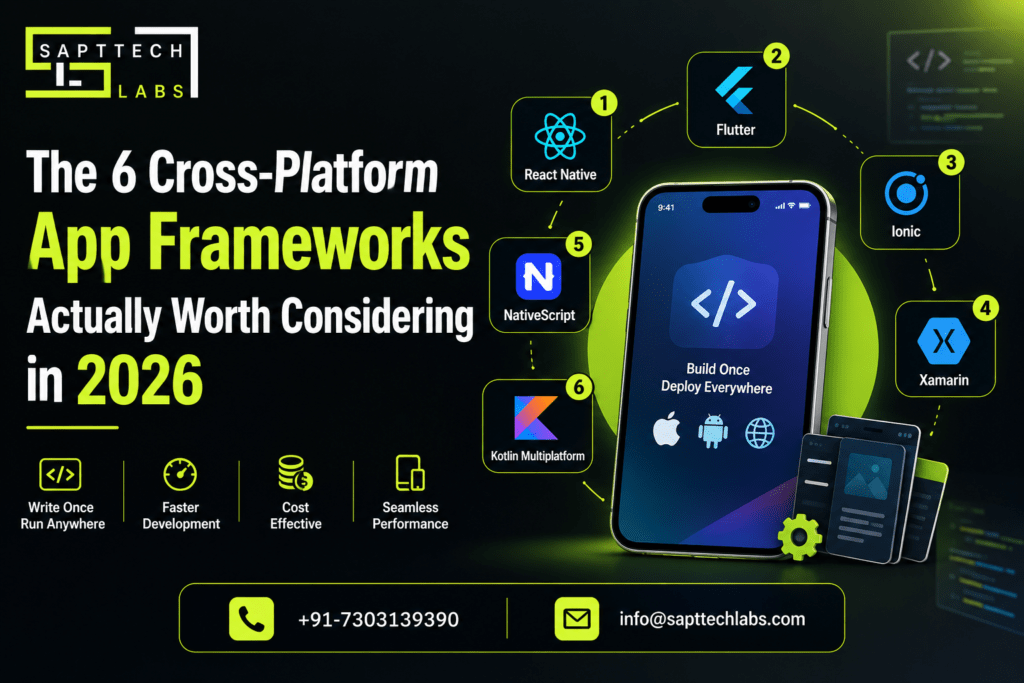
The 6 Cross-Platform App Frameworks Actually Worth Considering in 2026
Picking a cross-platform framework used to be simple: Flutter or React Native, pick your poison, move on. That's not really true anymore. The field has filled out, and the "best" answer now depends a lot more on who's building your app than it did even a couple of years ago.
If you're weighing your options for a 2026 build, here's an honest look at where things stand including where we'd steer you at SaptTech Labs when clients bring us this exact question.
Featured Snippet: What Is the Best Cross-Platform App Development Framework in 2026?
Flutter and React Native are still the two names everyone reaches for first, and for good reason. Flutter tends to win when the interface needs to look and feel identical no matter what device it's on. React Native wins when your team already lives in JavaScript or TypeScript and you don't want to retrain anyone. Kotlin Multiplatform, .NET MAUI, Ionic, and NativeScript round things out for more specific situations, like; enterprise stacks, existing Microsoft investments, web teams dipping a toe into mobile, that kind of thing.
Book A Free Consultation!
What Is Cross-Platform App Development?
The pitch is straightforward: write your code once, ship it to Android and iOS both, and skip the cost of maintaining two completely separate native apps. In practice, how much code you actually get to reuse varies wildly by framework as some share almost everything, others just share the business logic and let each platform keep its native UI layer. Neither approach is wrong. They just solve different problems.
The framework that fits depends on how complicated your app is, how much raw performance you need, what native features you're tapping into, and what your developers already know how to do.
Top 6 Cross-Platform App Development Frameworks in 2026
Flutter
Google's entry, built on Dart. What sets it apart is how much control you get over the UI that Flutter renders its own widgets rather than leaning on native components, so what you design is exactly what ships on every device. It's a natural fit for e-commerce and fintech apps, MVPs, and anything where a consistent, polished look matters more than blending in with the host OS.
React Native
Meta's framework, and probably still the one with the biggest community behind it. If your team already knows React, the learning curve here is close to zero, and there's a genuine advantage in sharing knowledge (sometimes even code) between your web and mobile projects. Social apps, e-commerce, content platforms: anywhere a JavaScript team is already in place, this is the obvious pick.
Kotlin Multiplatform
This one plays by different rules. Instead of sharing the whole app, KMP lets you share the business logic and the stuff that doesn't need to look different on Android versus iOS; while keeping native UI on each platform. It's a smart middle ground for teams that don't want to give up native performance and feel tired of writing (and debugging) the same logic twice.
.NET MAUI
Microsoft's answer, built around C#. If your organization already runs on Azure and the .NET ecosystem, MAUI slots in without much friction. It shows up most often in enterprise and internal tooling contexts, less so in consumer apps chasing a distinctive look.
Ionic
Built on HTML, CSS, and JavaScript, with tools like Capacitor bridging into native device features when needed. It's less suited to graphics-heavy or processing-intensive apps, but for business tools, prototypes, and content-driven apps, it lets web teams get into mobile without learning a new stack from scratch.
NativeScript
JavaScript and TypeScript developers get direct access to native platform APIs here. The ecosystem is smaller than the big names, so you won't find the same depth of community support, but for specific integrations it can still be the right tool for the job.
Cross-Platform App Development Frameworks Comparison
Framework | Language | Best for | Standout strength |
Flutter | Dart | Custom, consistent UI | Visual consistency across platforms |
React Native | JavaScript/TypeScript | Startups, JS-heavy teams | Huge ecosystem |
Kotlin Multiplatform | Kotlin | Native-first apps | Shared logic, native UI |
.NET MAUI | C# | Enterprise apps | Deep Microsoft integration |
Ionic | HTML/CSS/JS | Web-first teams | Reuses existing web skills |
NativeScript | JavaScript/TypeScript | Native API access | Direct native platform access |
How to Choose the Best Cross-Platform Framework?
Skip the popularity contest and start with what your app needs to do.
How complex is it really? A simple internal tool doesn't need the same horsepower as a consumer app with heavy animation or real-time data. If your app leans on intensive graphics, real-time processing, or deep hardware integration, that narrows the field fast — some frameworks handle that better than others.
Then there's your team. JavaScript developers will move faster in React Native or Ionic. C# developers will feel at home in .NET MAUI. Trying to force a team into an unfamiliar language just because a framework looks good on paper usually backfires.
UI matters too. If pixel-perfect consistency across devices is non-negotiable, Flutter tends to deliver. If a native look and feel is the priority, Kotlin Multiplatform is worth a closer look.
And don't forget the boring stuff — cost, and how the framework holds up five years from now. Cross-platform development generally cuts down on duplicated work, though almost every app ends up needing some platform-specific code eventually. Before committing, it's worth checking how mature the ecosystem is, how many developers you could hire if you needed to scale the team, and what ongoing maintenance actually looks like.
Why bother with cross-platform at all?
A few reasons keep coming up:
- Development moves faster when you're not writing the same feature twice.
- Costs drop because you're not maintaining two parallel codebases.
- Updates are easier to roll out when most of your components are shared.
- You reach a wider audience without doubling your engineering headcount.
- Branding stays consistent because the UI comes from one shared source.
- For startups especially, it means validating an idea across both major platforms without burning through your runway first.
Frequently Asked Questions
What's actually the best framework in 2026?
Flutter and React Native are the strongest general purpose picks, but "best" really comes down to your team, your performance needs, and the experience you're trying to build.
Is Flutter better than React Native?
Not universally, but they're optimized for different things. Flutter gives you tighter control over rendering and UI; React Native leans on its ecosystem and whatever React knowledge your team already has.
Does cross-platform actually save money?
Usually, yes, because you're reusing code instead of building twice. But complexity, integrations, and testing can eat into those savings fast as we've seen budgets slip when teams underestimate the platform specific work still needed.
What should startups use?
Flutter and React Native are the go-to choices, mainly because they get you to market faster on both platforms at once. Which one fits better depends on your product and your team's existing skills.
Can enterprises rely on cross-platform frameworks?
Absolutely. Flutter, React Native, Kotlin Multiplatform, and .NET MAUI all show up in enterprise environments regularly. The due diligence just needs to cover security, scalability, integrations, and long-term maintenance before you commit.
Bottom line
There's no single right framework, just the one that fits what you're building. Weigh performance needs, team skills, project complexity, and budget before you lock anything in. Get that match right and you'll spend a lot less time fighting your tools later.
Not sure which one fits your project? That's the exact conversation we have with clients at SaptTech Labs before a single line of code gets written, so reach out to us and we'll help you figure it out.