
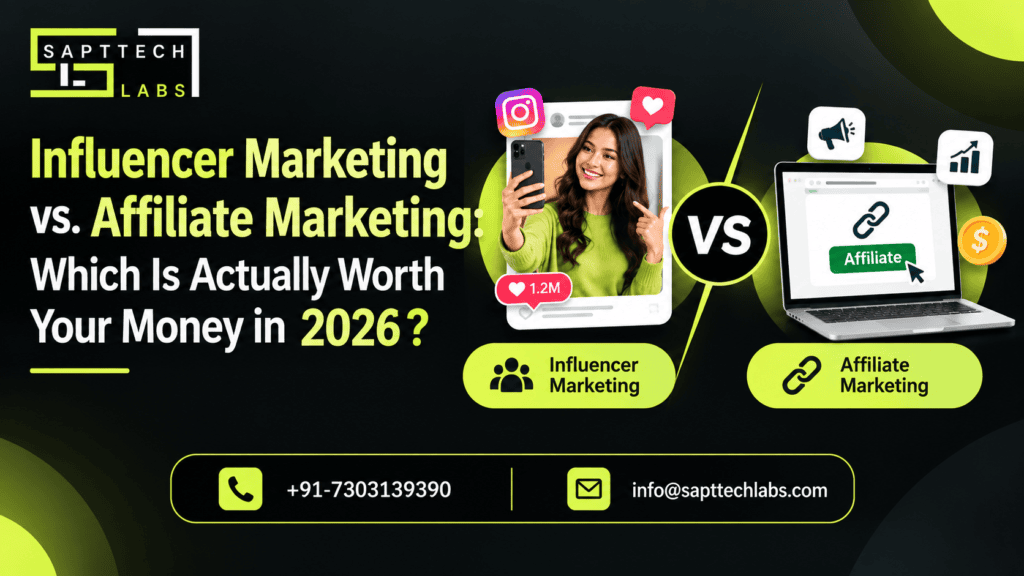
Influencer Marketing vs. Affiliate Marketing: Which Is Actually Worth Your Money in 2026?
We've had this conversation with at least a dozen founders over the last year. They come in with a marketing budget, a decent product, and one burning question: do I pay someone to talk about my brand, or do I pay someone only when they actually sell it for me?
That's the whole fight in a nutshell. Influencer marketing and affiliate marketing get lumped together constantly, and we get why both involve outside creators, both live on social media, both promise "authentic" reach that ads can't buy anymore. But they're built on completely different logic, and mixing them up is how brands end up disappointed.
So let's actually sort this out. Not in theory, but in the messy, budget limited reality most businesses operate in.
What We're Really Comparing
Influencer marketing is a relationship. You find someone with an audience that trusts them, you pay them (cash, product, or both) to talk about your brand, and you hope their audience listens. The payment usually happens whether or not anyone buys anything. You're betting on reach and credibility.
Affiliate marketing flips that around entirely. You give someone a unique link or code, and they only get paid when it actually converts into a sale. No conversion, no commission. It's performance based by design and the creator carries some of the financial risk alongside you, not just you alone.
Neither one is "better" in some abstract sense. They're tools for different jobs, and 2026 has made that gap even more obvious than it was two years ago.
Book A Free Consultation!
Why This Debate Feels Different in 2026
A few things have shifted that make this comparison worth revisiting instead of just recycling old advice.
Ad costs on Meta and Google haven't gone down, but they've kept climbing as more brands compete for the same eyeballs. That's pushed a lot of marketing budgets toward creators, because a genuine recommendation still cuts through in a way a banner ad never will.
At the same time, brands got burned. Plenty of companies dropped serious money on influencer campaigns in 2023 and 2024 that generated likes, comments, maybe a nice screenshot for the pitch deck and basically no sales. That hangover is real, and it's part of why affiliate marketing has quietly become the favorite of performance-focused teams. You only pay for what works. Hard to argue with that when budgets are tight.
But here's the thing people miss: affiliate marketing struggles to build the kind of brand awareness that gets someone to even consider you in the first place. You can't affiliate-link your way into someone's head. Somebody still has to hear your name before they'll click a discount code for it.
Influencer Marketing: What It's Actually Good At
Let's give credit where it's due. Influencer marketing does something affiliate marketing simply can't and it builds recognition and trust before a purchase decision even exists.
Think about the last time you bought something because a creator you follow mentioned it once, months before you actually needed it. That's brand-building. It's slow, it's hard to measure precisely, and it drives marketing teams crazy because the ROI doesn't show up in a neat spreadsheet column. But it works, and it compounds.
Influencer marketing tends to shine when:
- You're launching something new and nobody knows your name yet
- Your product benefits from being shown, not just described (beauty, fashion, food, fitness gear)
- You're playing a longer game and care about brand equity, not just this month's sales
- You want to reach a very specific niche audience fast, through someone who already has their trust
The catch? You're paying upfront, often with no guarantee of results. A creator with a million followers might get you three sales. Another with twenty thousand might sell out your inventory in a day. Follower count has never been a reliable predictor of anything, and honestly, treating it like one is probably the single biggest mistake brands still make in 2026.
Affiliate Marketing: What It's Actually Good At
Affiliate marketing is the accountant's favorite child. Every dollar spent is tied to a dollar (or more) earned. There's something deeply comforting about that, especially if you've been burned by a flashy campaign that didn't move the needle.
It works especially well when:
- Your product has a clear price point and an obvious purchase path (think ecommerce, SaaS subscriptions, online courses)
- You want to scale without constantly renegotiating flat fees with every new creator
- You're comfortable playing a longer game with a network of smaller creators rather than betting big on one or two names
- You already have some brand recognition, so people aren't clicking a link for a brand they've never heard of
But affiliate marketing has a chicken-and-egg problem nobody talks about enough. Good affiliates want to promote products people are already curious about, but nobody wants to spend their credibility pushing something unknown for a 10% commission. So if you're a brand-new company with zero recognition, you might struggle to recruit affiliates worth having at all. They'll want proof the audience already wants what you're selling.
There's also the tracking and payout headache. Attribution isn't perfect. Someone might see an affiliate post, forget about it, then buy directly two weeks later after a Google search — and the affiliate gets zero credit for the sale they actually influenced. That's a real limitation, not a minor technicality.
So, Which One Should You Actually Pick?
Honestly? Asking "which is better" is a bit like asking whether a hammer or a wrench is the better tool. Depends entirely on what you're building.
If I'm being blunt about it: if nobody's heard of you yet, affiliate marketing alone probably won't save you. You need some initial spark of awareness and that's where influencer marketing, even in small doses, tends to do the heavy lifting. Once people know who you are, affiliate programs become a much more efficient way to keep the sales flowing without torching your budget on flat fees.
A lot of the smartest brands I've watched in 2026 aren't choosing one over the other. They're running both, deliberately, at different stages of the customer journey.
Here's roughly how that plays out in practice:
Early stage (brand awareness): Lean into influencer partnerships, ideally with mid-tier or micro-creators whose audiences trust them more than they trust a celebrity. You're not expecting instant sales. You're planting seeds.
Growth stage (conversion and scale): Layer in an affiliate program once you've got some proof of concept and word-of-mouth momentum. This is where you squeeze efficiency out of every marketing dollar, because now people already half-know who you are.
Ongoing (both, tuned differently): Keep a small stable of influencer relationships for launches and big moments, while your affiliate program runs quietly in the background, generating steady, measurable revenue month over month.
A Few Things I'd Actually Watch For in 2026
Platforms have gotten smarter about detecting fake engagement, so vanity metrics matter even less than they used to. Don't let a creator's follower count do your thinking for you and ask for their actual engagement rate and, if you can get it, past conversion data from other brand deals.
Affiliate fraud has also gotten more sophisticated, from cookie stuffing to fake traffic. If you're running an affiliate program, invest in decent tracking software rather than trusting a spreadsheet and good faith.
And regulation is tightening almost everywhere. The FTC (and equivalent bodies elsewhere) has been cracking down harder on undisclosed sponsorships. Whichever route you go, make sure your creators are actually labeling paid content properly. It's not optional anymore, and the fines aren't hypothetical.
The Honest Answer
If you forced us to pick just one for a brand with a limited budget and no existing audience, we'd learn influencer marketing first — even a modest, scrappy version of it — because awareness has to exist before conversion can happen. But if you've already got some recognition and just need to turn browsers into buyers more efficiently, affiliate marketing will stretch your budget a lot further.
The brands that win in 2026 probably won't be the ones arguing about which strategy is objectively superior. They'll be the ones who figured out that the real question isn't influencer versus affiliate and it's what stage your brand is actually in, and which tool fits that stage right now.