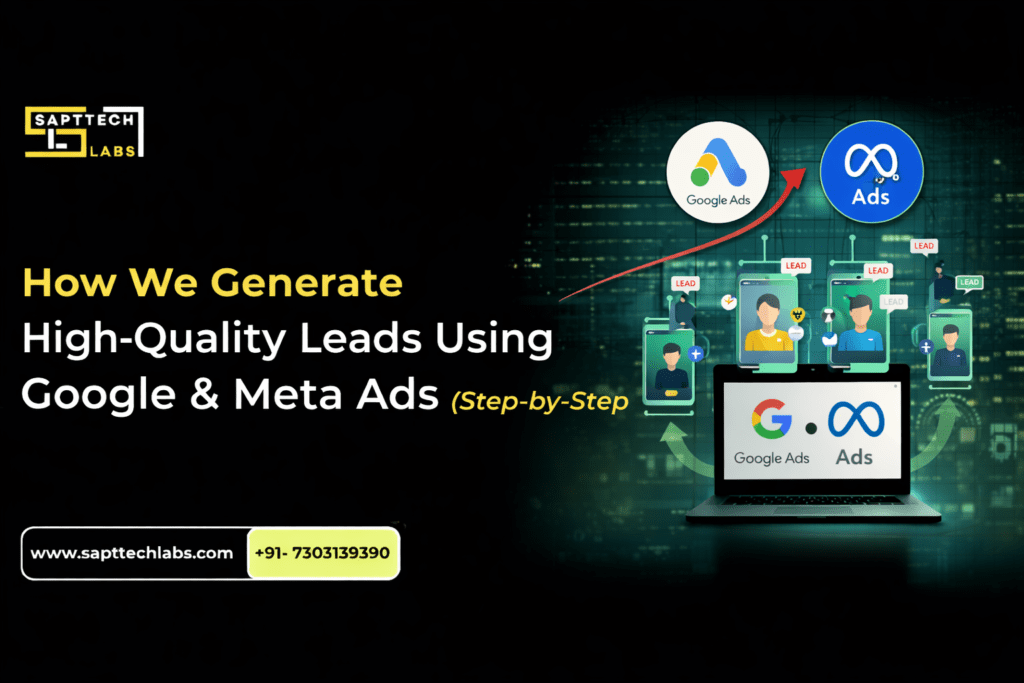
How We Generate High-Quality Leads Using Google & Meta Ads (Step-by-Step Strategy)
In today’s competitive digital market, businesses need more than just traffic, they need high-quality leads that convert into paying customers. Platforms like Google Ads and Meta Ads (Facebook & Instagram) have become two of the most powerful tools for generating targeted leads when used strategically.
At our agency, we follow a structured, data-driven approach to attract the right audience, optimize campaigns, and deliver consistent lead generation results. This step-by-step strategy explains how we generate high-quality leads using Google and Meta Ads while keeping campaigns optimized for AIO (AI Optimization) and GEO (Geographic Targeting Optimization).
1. Understanding the Ideal Customer (Audience Research)
Before launching any ad campaign, the first step is deep audience research.
We identify:
- Target demographics (age, gender, location)
- Interests and behaviors
- Pain points and buying intent
- Search queries and customer needs
Why this matters
Proper research ensures ads are shown to people who are actively looking for the service, improving both lead quality and conversion rates.
For GEO optimization, we also analyze:
- High-performing cities or regions
- Local demand for services
- Time zones and user activity patterns
This allows campaigns to target the right people in the right location.
2. Keyword & Intent Strategy (For Google Ads)
Google Ads works best when you target high-intent keywords.
We divide keywords into three categories:
High Intent Keywords
These are people ready to buy or inquire.
Examples:
- “best digital marketing agency near me”
- “online tuition for class 12”
- “mobile app development company”
Problem-Based Keywords
These users are looking for solutions.
Examples:
- “how to improve website traffic”
- “best online tutoring sites”
Competitor Keywords
Targeting users already considering competitors.
3. Smart Campaign Structure
A well-structured campaign improves performance and reduces ad costs.
Our typical structure:
Google Ads Campaign
Campaign (Service Based)
- Ad Group 1 – High Intent Keywords
- Ad Group 2 – Long Tail Keywords
- Ad Group 3 – Competitor Keywords
- Ad Group 1 – High Intent Keywords
Meta Ads Campaign
Campaign (Lead Generation / Conversions)
- Ad Set 1 – Interest Targeting
- Ad Set 2 – Lookalike Audience
- Ad Set 3 – Retargeting Audience
- Ad Set 1 – Interest Targeting
This structure helps optimize budgets and identify winning audiences faster.
4. Creating High-Converting Ad Creatives
Even the best targeting won’t work if your ads are not engaging.
We create ads with:
- Clear value proposition
- Problem-solution messaging
- Strong call-to-action (CTA)
- Social proof or trust signals
Example CTA
- Get Free Consultation
- Book Your Demo
- Start Learning Today
- Claim Your Free Trial
On Meta Ads, visual creatives perform best due to Andromeda update by Meta:
- Short videos
- Carousel ads
- Educational graphics
- Testimonials
For Google Ads, strong headlines and extensions improve click-through rate.
5. Landing Page Optimization
Driving traffic is only half the job. A high-converting landing page is critical.
Our optimized landing pages include:
- Clear headline and offer
- Quick lead form
- Mobile-friendly design
- Testimonials and trust badges
- Fast loading speed
- Strong CTA buttons
Conversion rule
The landing page must answer three questions instantly:
- What is the offer?
- Why should the user trust you?
- What action should they take?
6. Retargeting Strategy (The Secret to More Leads)
Most users do not convert on the first visit.
That’s why retargeting is essential.
We create retargeting campaigns for:
- Website visitors
- Users who clicked ads
- People who watched videos
- Users who engaged on social media
These ads remind potential customers about your brand and bring them back to convert.
Retargeting can improve conversion rates by 30–70%.
7. AI & Data Optimization (AIO Strategy)
Modern advertising platforms use AI to optimize campaigns.
We use AI-driven optimization by:
- Monitoring conversion data
- Adjusting bidding strategies
- Testing multiple creatives
- Identifying high-performing audiences
Continuous testing helps us improve:
- Cost per lead (CPL)
- Click-through rate (CTR)
- Conversion rate
This ensures campaigns become more efficient over time.
8. GEO Targeting for Better Lead Quality
Not every location performs equally.
We optimize campaigns by:
- Targeting high-demand cities
- Excluding low-performing regions
- Adjusting budgets for high-conversion locations
- Running localized ads
Example:
Instead of targeting an entire country, we focus on cities with strong buying intent.
This improves both:
- Lead quality
- ROI
9. Continuous Testing & Scaling
Lead generation campaigns require constant improvement.
We continuously test:
- Ad creatives
- Headlines
- Audience segments
- Landing page layouts
- Budget allocation
Winning campaigns are then scaled gradually to generate more leads without increasing costs significantly.
10. Performance Tracking & Analytics
Data is the backbone of successful advertising.
We track:
- Cost per lead
- Conversion rate
- Return on ad spend (ROAS)
- Lead quality
- Customer acquisition cost
Using analytics tools helps us understand what works and what needs improvement.
Final Thoughts
Generating high-quality leads through Google Ads and Meta Ads requires more than just running ads. It demands a well-planned strategy, continuous optimization, and data-driven decision making.
By focusing on:
- Audience research
- High-intent keywords
- Strong ad creatives
- Optimized landing pages
- Retargeting strategies
- AI and GEO optimization
Businesses can build a reliable lead generation system that delivers consistent results.
When implemented correctly, Google and Meta Ads become powerful growth engines, helping businesses attract the right audience and convert them into loyal customers.