

How Cloud Migration Services Work: A Complete Guide for Businesses in UAE and Dubai
Every business eventually hits the same wall. Your servers are aging, your storage is maxed out, and your IT team is spending more time firefighting than building. That's usually the moment a company starts looking seriously at the cloud—and specifically, at cloud migration services.
But "moving to the cloud" isn't a single click. It's a structured process, and understanding how it actually works helps you avoid the downtime, data loss, and budget overruns that scare so many businesses away from making the switch.
It's a guide to understanding how these services work, their significance, and how to select the right partner in the UAE.
What Are Cloud Migration Services?
Cloud migration services are used to shift the data, applications, and entire IT infrastructure of a business from legacy on-premise hardware (or one cloud platform) to a modern cloud platform, such as AWS, Microsoft Azure, or Google Cloud.
Instead of your company managing physical servers in a back room, everything runs on remote infrastructure managed by cloud providers. A migration partner handles the planning, the technical heavy lifting, and the testing so your business doesn't feel the disruption.
Book A Free Consultation!
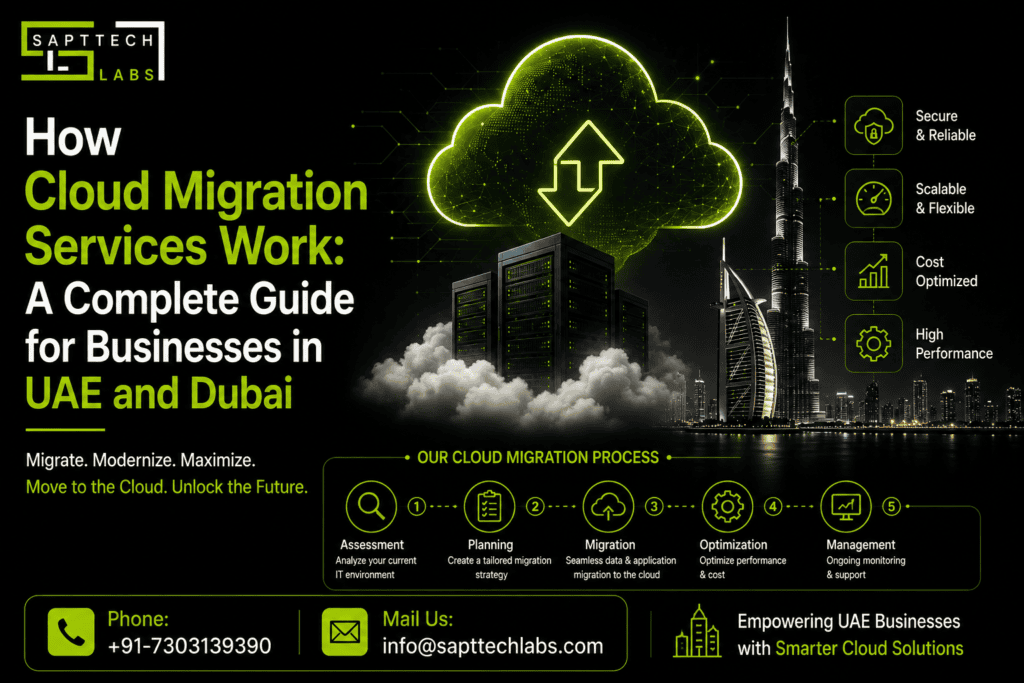
How Cloud Migration Services Work - Step by Step
Here's the stage wise process which a good provider actually follows:
- Before any moves are made, the provider assesses your existing systems that include servers, applications, databases, dependencies, and security configuration. This step helps to determine whether it is possible to move the step without re-architecting it, re-architect it, or retire it entirely.
- The team creates a migration plan and strategy based on their assessment. Typically, it takes one of several forms:
- Rehosting (also known as "lift and shift") — moving the apps without significant changes
- It is possible to do small optimizations while the move—these are called re-platforming.
- Refactoring — making applications cloud-native. Cloud-Native Application Refactoring.
- Repurchasing — replacing all with SaaS
- Selecting the appropriate cloud environment: public, private, or Hybrid – depending on your compliance requirements, cost, and level of control over your infrastructure.
- Data migration and testing- Data is transferred in phases, not all at once. Each phase is tested for integrity, speed, and security before the next batch moves. This is where experienced providers earn their fee — poor testing here is the number one cause of migration failures.
- Go-live and optimization- Once everything is validated, the switch goes live. A good provider doesn't disappear after that; they monitor performance, tune costs, and fix any teething issues in the following weeks.
Benefits of Cloud Migration Services
While you may not be sure of the value of migration yet, here are some of the benefits businesses generally see:
- Reduced infrastructure expenses (no more on-premise servers, cooling or hardware refreshes)
- The ability to grow your resources when you need them and to reduce them when they are not being used.
- More resilient disaster recovery—data is replicated at several sites, and not stored in just one server room
- Security is better — leading cloud providers spend much more on security than typical in-house teams do, and that's a good thing.
- Better performance — Most modern cloud systems offer better performance than legacy on-premise setups.
- Ability to access systems and data securely from around the world — remote-ready operations
- More rapid innovation, with new tools and updates automatically installed
Why UAE Businesses Are Moving Faster to the Cloud
In the UAE, embracing a digital transformation, from Dubai's smart city projects to the country's overall transformation of governance to be data-driven, has turned enterprise cloud migration services in Dubai into a competitive must-have rather than a mere IT upgrade.
There are a number of reasons why companies are moving to Dubai, Abu Dhabi and Sharjah, UAE:
- UAE regulations have more data residency requirements, which providers here in UAE are more familiar with than generalists overseas
- Scalability demands that cannot wait for hardware purchases—such as rapid business growth in retail, logistics, fintech and real estate
- Cloud adoption incentives for enterprises promoting modernization of the cloud.
- A fast-moving, competitive environment in which outdated systems run efficiently in the background, costing companies customers.
That's why the demand for professional cloud migration services in the UAE has increased rapidly: Businesses need someone who has insight into the technology and the regulations.
How to Choose a Cloud Migration Services Provider in UAE
Not all providers will be the same when it comes to handling your migration. What to really look for when entering into a contract:
- Local experience - someone who has moved a business to the UAE before will be familiar with UAE data residency laws, industry compliance, and local infrastructure nuances.
- A documented and explicit migration plan - (If they do not provide you with a step-by-step plan, it is a red flag).
- Security-first approach - ask them specifically how they are handling data encryption, access control, and compliance during the transition.
- Post-migration support - the true benefit becomes apparent once you get going, after go-live, as you are involved in continuous optimization and troubleshooting.
- Transparent pricing - cloud costs can quickly ramp up if no one is controlling them; a good provider addresses cost controls from the outset.
- Look for examples that have been successful - seek out actual case studies of professional cloud migration services in UAE that have been used by companies that are comparable in size and industry to your own.
Who Actually Needs This?
Cloud migration doesn't have to be an enterprise project. It's relevant for:
- Startups wanting to scale without investing in hardware early.
- SMEs that need more space than what is available in their current office.
- Businesses with legacy systems that are too costly and risky to upgrade.
- Retail or e-commerce businesses need to manage the surge of traffic without crashes.
- Any financial or healthcare institutions that require the flexibility and security of the airtight environment provided by financial and healthcare organizations.
Final Thoughts
Cloud migration isn't just about moving data to another place; it's about putting your business in a position to move faster, spend more wisely, and be more secure all while in a market that isn't slowing down anytime soon. Whether you're going from a start-up to a larger company or vice versa, the right partner can make the transition smooth and effective and help prevent any disruptions.
If you're evaluating cloud migration services for businesses in the UAE, start with a provider who can walk you through their process in plain language — not just jargon. That clarity, more than anything else, is usually the sign you're in good hands.
Frequently Asked Questions
How long does a typical cloud migration take?
It depends on the size and complexity of your infrastructure, but most mid-sized business migrations take anywhere from a few weeks to a few months, done in phases to avoid disruption.
Is cloud migration safe for sensitive business data?
Yes, when handled by an experienced provider. Data is encrypted during transfer, tested at every stage, and backed up before any final cutover.
Do I need to migrate everything at once?
Most providers recommend a phased migration approach, which involves migrating less critical systems first and then migrating more critical systems last to make sure the migration process is successful before it impacts any core systems.
What's the biggest risk in cloud migration?
Lack of planning and testing. The migration issues are primarily due to haste in data validation, not the cloud technology.