

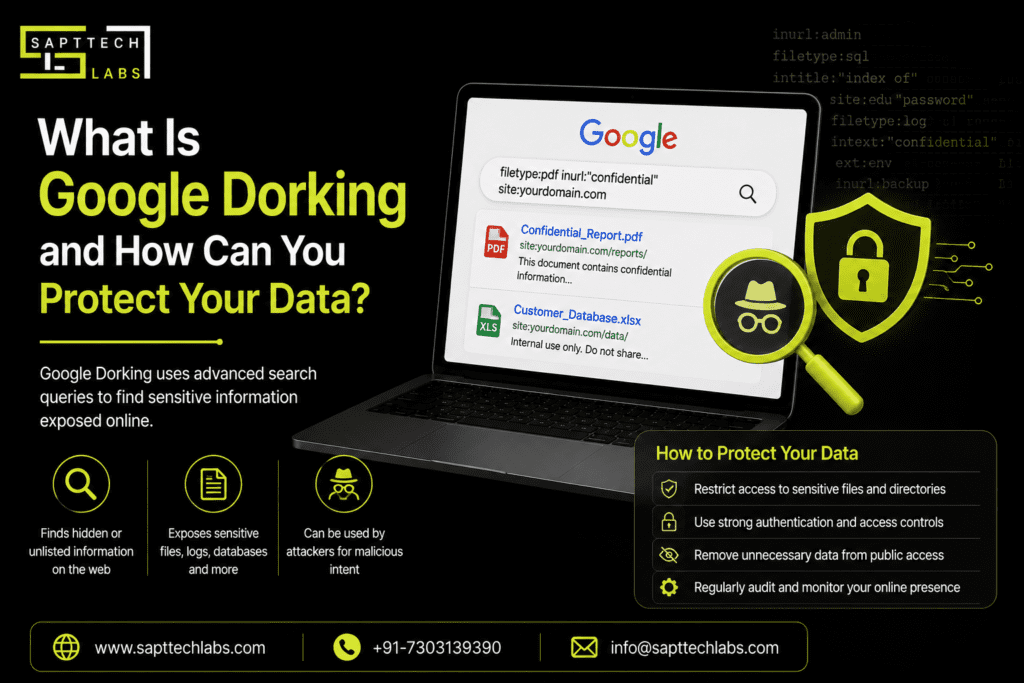
What Is Google Dorking and How Can You Protect Your Data?
In the modern-day world where everything is online and digitized, search engines help you find all sorts of information. But along with the benefits come certain risks as well. The risk of sensitive information getting exposed on the internet can be avoided by knowing one method which is quite popular in cybersecurity. It is called Google Dorking or Google Hacking.
What Is Google Dorking?
Google Dorking refers to the use of Google Search operators to search for certain pieces of information which may be public, yet not necessarily easy to find.
The term Google Dorking is widely used by cybersecurity experts in order to identify vulnerabilities on a particular system. However, Google Dorking can also be employed by cybercriminals to expose sensitive information.
How Does Google Dorking Work?
Google indexes billions of websites and files. When any website leaks data by mistake, and this leak is crawled by the search engine, it gets indexed.
The advanced search operators allow narrowing the search results, which include:
- Specific file types
- A particular website
- Publicly available directories
- Exposed documents
The search operators themselves are legal search tools. The problem is created when the sensitive data gets leaked online.
Book A Free Consultation!
Why Is Google Dorking a Security Concern?
Google Dorking is able to find information that the website owner does not want to be revealed.
Potentially Exposed Data Includes:
- Personal data
- Staff directories
- Internal documents
- Available backups
- Config files
- Login pages
- DB exports
- Cloud storage links
- Server error messages
While all the information above might already be publicly available, there are many organizations that are not aware of that.
Common Risks of Google Dorking
1. Exposed Data
Sensitive data can get exposed through search engine results owing to improper website configuration.
2. Privacy Violations
Private data like email IDs, phone numbers, and business-related information can be compromised.
3. Increased Cybersecurity Risks
Attackers can do reconnaissance on their targets prior to performing any attack.
4. Reputation Damage
Exposure of data can harm the reputation of an organization.
5. Compliance Issues
There might be legal consequences if sensitive information of customers is leaked online.
Signs Your Data May Be Exposed Online
Beware of the following warning signs:
- Sensitive information appears in searches on the Internet.
- Unapproved access to company files is possible.
- Prior backups are accessible by everyone.
- Employee information is available on the Internet.
- Online directory listings are visible to all.
- Insecure cloud settings.
How to Protect Your Data from Google Dorking
Information security encompasses a number of technical controls along with constant monitoring.
Utilize Effective Access Controls
- Limit access to sensitive data.
- Provide authentication requirements.
- Employ role-based access control policies.
- Evaluate regularly access rights of users.
Secure Website Configuration
- Ensure that directory listing is disabled.
- Eliminate all unnecessary files available publicly.
- Hide administrative interfaces from being publicly available.
- Update website software.
Control Search Engine Indexing
Use proper controls to avoid any sensitive data being indexed and thus available in search engines.
Best practices include:
- Disabling indexing of non-public directories.
- Disabling indexing of confidential pages.
- Controlling visibility of websites by search engines.
Conduct Regular Security Audits
Periodic evaluations will enable to uncover any exposure of data even before the hacker gets to it.
Audit zones must cover:
- Public web sites
- Downloadable files
- Cloud data
- Employees' data
- Archive data
Monitor Your Digital Footprint
Search for:
- Company name
- Employees' data
- Public documents
- Subdomains on the website
- Shared resources
Continuous monitoring helps detect accidental exposure quickly.
Best Practices for Businesses
The following should be taken by organizations for proactive cybersecurity.
Create a Data Protection Policy
Include:
- Classification of data
- Data access control policy
- File sharing policies
- Security assessments
Train Employees
Employees should understand:
- Secure file sharing
- Privacy protection methods
- Risk of data exposure
- Website and cloud basic security
Implement Security Monitoring
Use tools and services that help identify:
- Exposure of resources
- Server misconfiguration
- Publicly exposed files
- Unintentional data exposure
Regularly Remove Unused Data
Delete:
- Old backups
- Obsolete documents
- Testing environment
- Unneeded websites
Conclusion
In conclusion, Google Dorking stresses the significance of proper cyber security and data security. Although search operators are legal and legitimate, the exposed data poses many risks both in terms of privacy and security issues. In order to lower the risk of being vulnerable to this type of attack, one has to ensure that his/her website is secure and access to information is restricted.
It’s time to embrace that future.
Frequently Asked Questions
Is Google Dorking Illegal?
Google Dorking is not unlawful, since it is a process performed by a search engine. However, misusing the found information could be unlawful.
Can Google Dorking Affect Small Businesses?
Yes. Small enterprises may be vulnerable due to their weak cybersecurity protocols and low budget in terms of cybersecurity.
How Often Should You Check for Data Exposure?
Website auditing by security experts suggests that website audit should be carried out regularly.
Can Personal Information Be Found Through Google Dorking?
Yes, if your personal information can be found on the Internet but is not protected and indexed by search engines.